
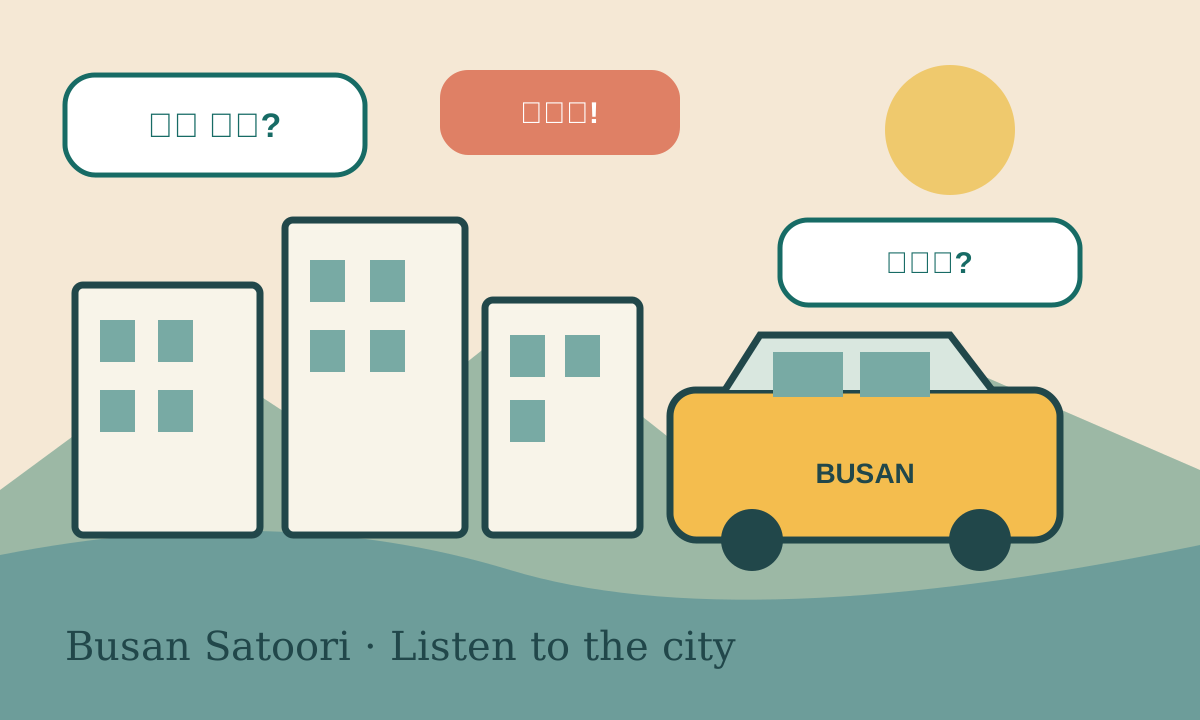
You don't need fluent Korean to recognize the energy of Busan satoori. These five expressions can help you understand conversations around taxis, markets, restaurants and everyday encounters.
1. “Eode-gano?” — 어데 가노?
Meaning: “Where are you going?”
Where it fits: This dialectal question can come up in casual conversation about a destination. A driver speaking politely to a passenger may instead say “어디 가세요?” (Eodi gaseyo?). If you need a taxi, say your destination clearly or show it on your phone rather than copying the dialect.
Standard/polite alternative: 어디 가세요? — “Where are you going?”
2. “On-na!” — 온나!
Meaning: “Come here!”
Where it fits: You may hear this in familiar, lively conversation when someone calls a friend or family member over. It can sound commanding, especially when shouted over market noise.
Standard/polite alternative: 이리 와! is casual; 이쪽으로 오세요 is more polite. Visitors should generally avoid using 온나 with strangers.
3. “Mug-ura!” — 묵으라!
Meaning: “Eat up!” / “Go ahead and eat!”
Where it fits: This is a dialect-flavored, informal way to urge someone to eat. It captures a practical, no-fuss kind of hospitality you may encounter among family or familiar company. The exact pronunciation can vary.
Standard/polite alternative: 먹어라 is direct; 드세요 is polite. A simple “감사합니다” (Gamsahamnida, thank you) is a safe response.
4. “U-jja-no?” — 우짜노?
Meaning: “What are we going to do?” / “Oh no, what now?”
Where it fits: Someone sees a long queue, sudden rain or traffic and reacts with concern, surprise or sympathy. Tone decides whether it sounds worried, playful or dramatic.
Standard Korean: 어떡하지? / 어떻게 하지? — “What should I do?” / “What are we going to do?”
5. “Maj-da!” — 맞다!
Meaning: “Exactly!” / “That's right!”
Where it fits: You may hear it during animated conversation when someone strongly agrees. The word itself is also used in standard Korean; the regional flavor comes from intonation, rhythm and context rather than the word being exclusive to Busan.
Polite alternative: 맞아요 (Majayo) is a useful way to agree politely.
How to understand Busan satoori without sounding rude
- Listen before copying. A phrase used among friends can sound abrupt with strangers.
- Use 안녕하세요 (hello), 감사합니다 (thank you) and 주세요 (please give me) when you need safe, useful Korean.
- Don't assume every Busan resident speaks the same way; age, background and setting all matter.
- Read the tone and situation along with the words.
The goal isn't to imitate an accent. It's to understand more of the everyday conversations that make a trip feel local.
Frequently Asked Questions
What does “Eode-gano?” mean in Busan dialect?
It is a casual Busan-style way to ask “Where are you going?” Tone and relationship matter, so visitors should understand it rather than use it with strangers.
Is Busan dialect rude?
Not automatically. Intonation, age, relationship and situation shape how a phrase feels. A direct phrase among friends may sound abrupt with someone you have just met.
What Korean phrases are safest for travelers?
안녕하세요 (hello), 감사합니다 (thank you) and 주세요 (please give me) are useful polite phrases in most everyday situations.
Keep exploring: Busan local culture guide · Everyday culture and customs · Where to Eat in Busan by Neighborhood.